

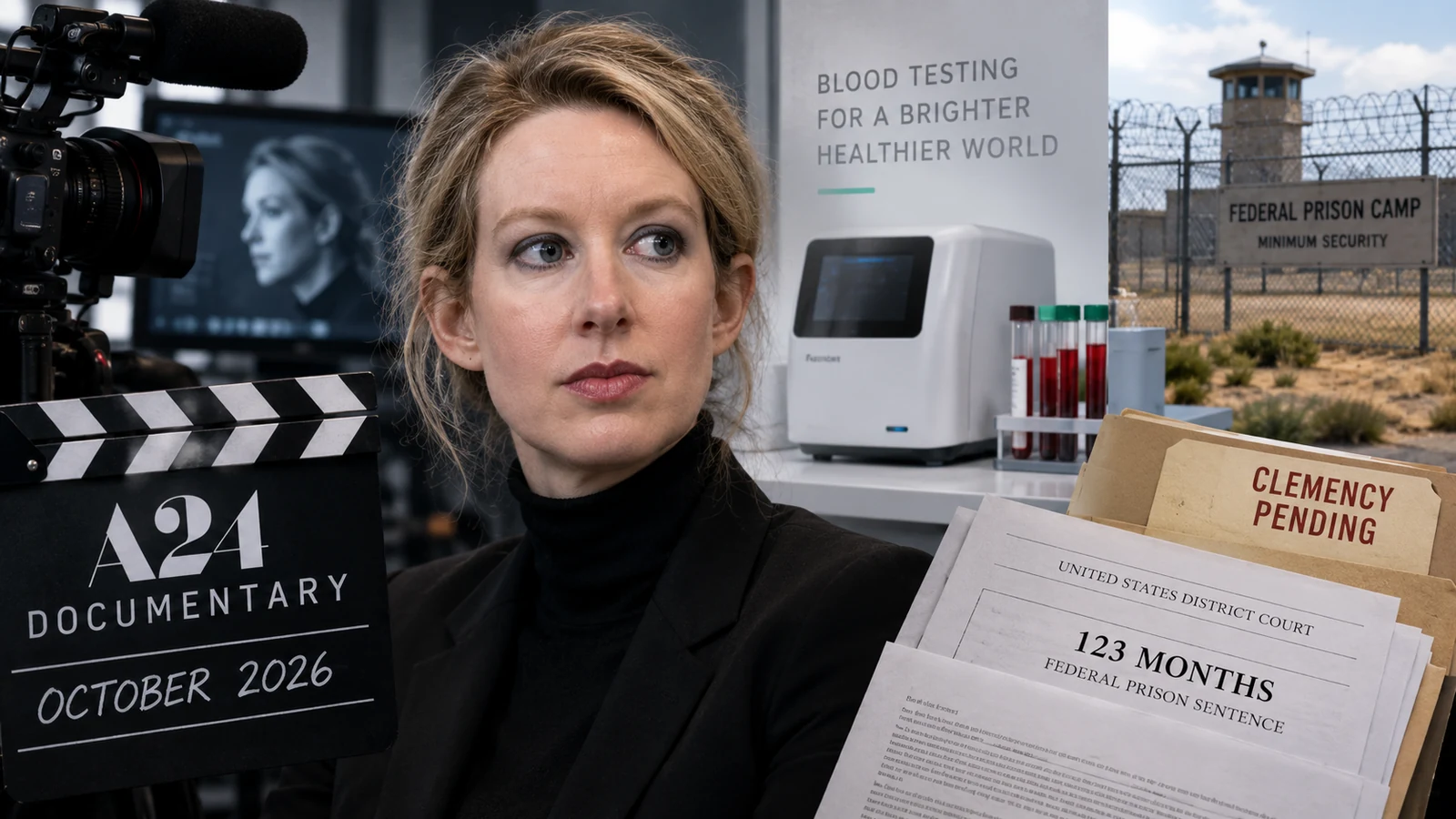
Elizabeth Holmes has returned to the center of U.S. pop-culture and legal conversation because of a documentary that was kept largely secret until the 2026 Telluride Film Festival. You Can See Everything, directed by Nathan Fielder and Lance Oppenheim and released by A24, begins shortly before the Theranos founder reported to federal prison in 2023. The project is unusual because Holmes participated directly, giving the filmmakers access to her home life in the final weeks before incarceration and continuing to argue that the public does not understand who she really is.
The film’s arrival does not change the legal record. Holmes was convicted by a federal jury in January 2022 on one count of conspiracy to defraud Theranos investors and three investor-related wire-fraud counts. She was sentenced in November 2022 to 135 months in prison. In March 2026, a federal judge reduced that sentence by 12 months under a sentencing-guideline change affecting certain first-time offenders, lowering the term to 123 months. She is serving her sentence at Federal Prison Camp Bryan in Texas and has also sought a presidential commutation.
What the new A24 documentary is and why its debut was a surprise
You Can See Everything was unveiled through a secret screening at Telluride on September 6. A24 describes the premise as beginning 34 days before Holmes goes to prison, when she invites a skeptical film crew to document her. Reporting on the completed film says Fielder and Oppenheim followed the story over roughly three years, turning what begins as an intimate portrait into an examination of performance, credibility, family, image-making, and the difficulty of determining what a highly media-aware subject wants a camera to believe.
The documentary runs nearly three hours and is scheduled for a U.S. theatrical release in October. Updated reporting has listed October 16 as the release date, while A24’s initial public messaging emphasized the October window. The teaser immediately drew attention because it places Fielder, known for uncomfortable documentary-style experiments, opposite Holmes, one of the most scrutinized figures in modern Silicon Valley. The tension is not simply whether Holmes repeats her defense; it is whether the film can reveal anything new about a person whose public persona was itself central to the Theranos story.
The conviction still matters more than the documentary narrative
Holmes founded Theranos and promoted the company as a revolution in blood testing. Federal prosecutors said she misled investors about the capabilities and commercial progress of the technology. On January 3, 2022, jurors convicted her on four investor-related counts. The same jury acquitted her on patient-related counts and could not reach a verdict on several additional investor counts, an important detail because the final conviction was narrower than some public summaries of the case suggest.
U.S. District Judge Edward Davila originally sentenced Holmes to 135 months, or 11 years and three months, in federal prison. The court also imposed three years of supervised release after imprisonment. Holmes and former Theranos executive Ramesh ‘Sunny’ Balwani were ordered to pay substantial restitution associated with the fraud case. Holmes has continued to dispute the interpretation of her conduct and pursued appeals, but the federal conviction and sentence remain in force. A documentary can challenge a viewer’s emotional interpretation of a defendant; it cannot rewrite a jury verdict.
Why her prison sentence changed in March 2026
On March 26, 2026, Judge Davila reduced Holmes’s sentence by one year, from 135 months to 123 months. The reduction was tied to a change in federal sentencing guidelines that can benefit certain first-time offenders with no criminal-history points. The judge’s decision did not overturn the conviction, pardon Holmes, or declare that the underlying fraud was less serious. It changed the length of the sentence under the revised guideline framework.
That distinction is especially important because public reporting often mixes three different mechanisms: a judicial sentence reduction, Bureau of Prisons credits and projected release calculations, and presidential clemency. They are not the same. A court can reduce the imposed sentence; the Bureau of Prisons administers credits and release planning under federal law; and the president can grant clemency. Because projected release dates can move as those systems interact, the most stable current legal fact is the court-imposed term of 123 months rather than any single reported future date.
Where the clemency request stands
Holmes submitted a request seeking commutation of her sentence, and the Justice Department’s Office of the Pardon Attorney listed the petition as pending earlier in 2026. A commutation would reduce or end the remaining prison term without erasing the conviction. A full pardon is a different form of clemency with different legal effects. The White House has not publicly announced a decision granting Holmes clemency, so any social-media claim that her release has already been approved should be treated as false unless it is supported by an official presidential action.
The clemency request also should not be confused with the March court ruling. The one-year reduction came from Judge Davila under the sentencing guidelines, not from President Donald Trump. The Justice Department’s public clemency database explains that a pending case remains under review and that details of the internal review are not normally shared. As of September 9, there is no verified public announcement that the petition has been granted.
Why Holmes continues to attract attention years after Theranos collapsed
Theranos became a defining Silicon Valley cautionary tale because it combined health care, venture capital, celebrity investors, secrecy, and a founder who was marketed as a visionary. That combination made the company’s collapse more than a business failure; it became a debate about due diligence, startup culture, board oversight, media narratives, and the dangers of treating bold claims as proof of scientific performance. Holmes’s black-turtleneck image and carefully controlled speaking style became symbols of that era, which is one reason dramatizations and documentaries continue to find audiences.
You Can See Everything enters that crowded field by giving Holmes unusually direct access to the camera. Viewers should keep two ideas in mind at once: the documentary may contain new material about Holmes’s private life and self-understanding, while the legal facts are independently established through court proceedings. The most useful way to watch is not to assume that intimacy equals exoneration or that a strange on-camera moment automatically proves guilt. The film is a new piece of media about the case, not a new trial.
How to evaluate new claims about Holmes as the documentary reaches theaters
A documentary built around direct access can produce information that is emotionally vivid but legally different from sworn testimony, exhibits, or judicial findings. Viewers may see private conversations, family interactions, explanations of Theranos, and Holmes’s own interpretation of why events unfolded. Those scenes can be important for understanding how she presents herself and how people close to her understand the case. They do not automatically prove disputed technical or financial claims. When the film makes a factual assertion about Theranos technology, investor communications, government conduct, or the criminal case, the strongest way to evaluate it is to compare that assertion with trial evidence, appellate decisions, SEC records, Justice Department materials, and contemporaneous reporting.
The same rule applies to clemency discussion. Public interest around a film can make a pending petition feel newly urgent, but a documentary release is not evidence that presidential action is imminent. The Office of the Pardon Attorney’s public status system is a more reliable indicator than viral posts, celebrity endorsements, or speculation about political relationships. If a commutation or pardon is granted, it will be documented as an official act. Until then, Holmes remains a federal prisoner serving the reduced 123-month sentence imposed by the court, and You Can See Everything should be understood as a new cultural document about her story rather than a change in her legal status.
Holmes’s case also remains financially consequential. Restitution is separate from the prison term, and a sentence reduction does not erase money owed under the judgment. That matters when readers see the documentary framed as a comeback story or public-image reset. The criminal case produced concrete penalties that continue after the media cycle moves on. A future commutation, if one were ever granted, could change the custody term without automatically resolving every financial consequence. The details would depend on the wording of the presidential action, which is another reason not to infer legal effects before an official clemency document exists.
The renewed attention is likely to continue through the October theatrical run, when more viewers can assess the film beyond festival reviews and a short teaser.
The renewed attention is likely to continue through the October theatrical run, when more viewers can assess the film beyond festival reviews and a short teaser.

