

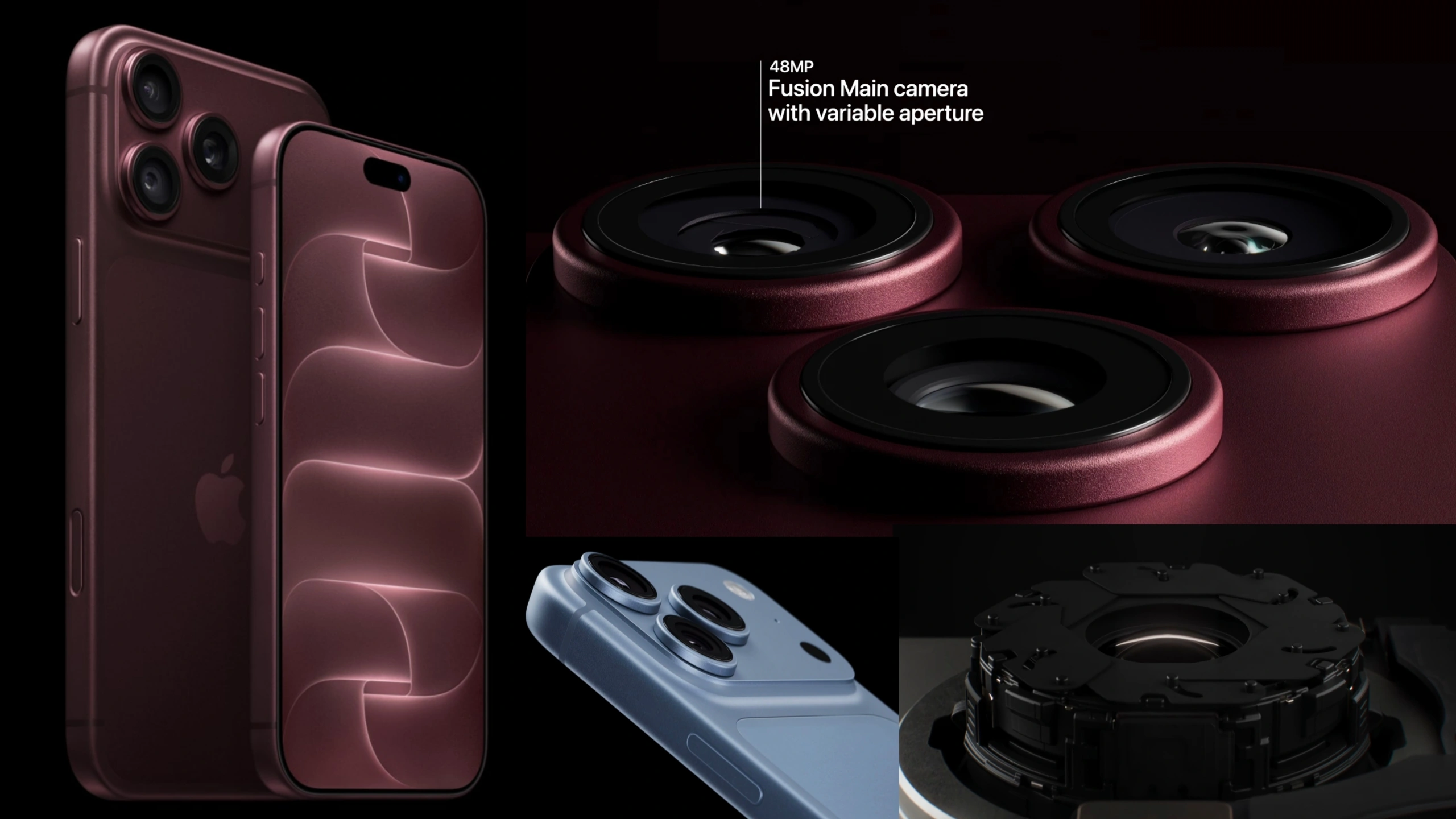
Apple’s iPhone 18 Pro and iPhone 18 Pro Max arrive with the same headline camera upgrade: a 48MP Fusion Main camera with a physical variable aperture. That makes the buying decision different from years in which the larger Pro Max held an exclusive camera advantage. In 2026, both models can switch among f/1.48, f/1.8, f/2.8 and f/4.0, both include Apple’s new manual Pro controls, and both pair the Main camera with 48MP Ultra Wide and 48MP Telephoto cameras. For photographers, the choice is therefore less about image-making capability and more about size, endurance and price.
In the United States, the iPhone 18 Pro starts at $1,199 and the iPhone 18 Pro Max starts at $1,299, with 256GB of storage standard on both. Preorders open September 12 and availability begins September 18. The $100 gap is small compared with the overall cost, but the larger model comes with a bigger body and Apple’s longest-rated iPhone battery life. The smaller Pro, however, gives buyers the full variable-aperture camera system in a more compact format. That parity is the most important fact for creators deciding between the two.
The variable-aperture camera is identical on both Pro models
Apple lists the same 48MP Fusion Main camera specifications for the iPhone 18 Pro and Pro Max: a 24mm primary field of view, an optical-quality 48mm 2x option, sensor-shift optical stabilization and four aperture settings from f/1.48 through f/4.0. Six laser-cut blades change the physical opening, and Apple’s automatic mode can choose an aperture based on light and desired depth of field. Users can also select settings manually through the Camera app’s new Pro controls.
This shared hardware means the Pro Max does not deliver a wider maximum aperture, a narrower minimum aperture or an exclusive aperture mode. The larger phone should therefore not be purchased on the assumption that its Main camera captures fundamentally different photographs. Image processing can vary slightly with thermal conditions or battery state in extreme use, but the underlying camera specification and A20 Pro processing platform are the same. For still photography, parity gives the smaller iPhone 18 Pro unusual value within Apple’s premium lineup.
The rest of the rear camera system is also closely matched
Both phones include a 48MP Fusion Ultra Wide with a 13mm equivalent field of view and f/2.2 aperture. The telephoto is a 48MP Fusion Telephoto with a 100mm 4x optical position and a 200mm 8x optical-quality option. Apple also lists digital zoom up to 40x. That three-camera structure matters because variable aperture affects only the Main camera; the Ultra Wide and Telephoto continue to use fixed apertures. Photographers will still change lenses when perspective or reach matters more than depth-of-field control.
Apple’s new Pro controls extend beyond aperture. Users can adjust shutter speed and white balance and view a histogram directly in the native Camera app. The company also supports ProRAW, Photographic Styles 3, 48MP macro photography and updated video workflows. Because those software tools are available on both models, creators can build the same shooting presets and editing habits whether they prefer the smaller Pro or larger Pro Max. Storage capacity, not camera access, becomes the more relevant configuration decision for high-volume photo and video users.
Battery life is the clearest Pro Max advantage for creators
Apple rates eSIM-only U.S. models for up to 36 hours of video playback on the iPhone 18 Pro and up to 45 hours on the iPhone 18 Pro Max. Video-playback tests are not the same as hours of active camera use, but the nine-hour rating gap strongly indicates more energy capacity in the larger model. Long recording sessions, travel photography, on-device editing and sustained 5G transfers all consume significant power, so the Pro Max offers a practical buffer for people who spend full days shooting away from a charger.
The larger battery can also matter indirectly to performance. Apple redesigned the thermal system around A20 Pro with a next-generation vapor chamber and says sustained performance improves substantially over the previous generation. Both devices receive that cooling architecture, but the Pro Max’s larger chassis and battery capacity give it more room to absorb long sessions without making the user think about power conservation as quickly. Creators working at events or in the field may therefore prefer the Pro Max even though the camera itself is not better.
The smaller iPhone 18 Pro can be the better street and travel camera
A compact body has advantages that specifications rarely capture. A smaller phone is easier to hold one-handed, less conspicuous in street photography and more comfortable on a stabilizer or compact rig. When variable aperture encourages more deliberate manual shooting, ergonomics become important because users may spend longer framing, adjusting exposure and reviewing images. The iPhone 18 Pro offers the same aperture range and lens set without requiring the larger footprint of the Pro Max.
Travelers also need to consider weight and pocketability over an entire day. A larger display is excellent for reviewing photos and editing video, but it can be cumbersome during walking tours, hikes or crowded events. The smaller Pro gives up battery endurance and screen area rather than camera capability. Buyers who already carry a battery pack or frequently return to a hotel, car or office charger may find that trade especially reasonable, making the $1,199 model the more balanced creator phone.
The Pro Max display is better for reviewing and editing in the field
The larger screen gives photographers and videographers more physical room for checking focus, examining fine detail, trimming clips and using editing controls. That can be valuable when working with 48MP photos or 4K video, where small framing errors are easier to notice on a bigger display. Apple’s redesigned Dynamic Island can show more live information, and iOS 27 brings broader interface changes, but the basic ergonomic advantage remains simple: a larger canvas is easier to inspect.
For mobile editors who finish social video, color-correct clips or select hundreds of images directly on the phone, the Pro Max can reduce the urge to move immediately to an iPad or Mac. Its additional battery endurance also complements those workflows. The question is whether that convenience is worth the larger size for every moment the phone is carried. A creator who mostly captures on iPhone but edits later on a computer may not receive as much value from the Pro Max screen.
Variable aperture changes how users can approach low light and group shots
At f/1.48, the Main camera prioritizes light gathering. That can help in restaurants, indoor events, nighttime streets and other scenes where a faster exposure reduces motion blur. At f/2.8 or f/4.0, the lens can keep more of a group or landscape in focus. Apple specifically demonstrates the narrower setting as useful when subjects sit at different distances from the camera. Because both Pro sizes have the same mechanism, these benefits are equal regardless of the chassis users choose.
The practical distinction may emerge from how long users can stay in demanding modes. Repeated Night mode shots, 4K recording, ProRAW capture and on-device processing draw more power than casual photography. A Pro Max owner has more battery headroom for those sessions, while a smaller Pro owner gets the same shot-making options but may need to charge earlier. That is a workflow difference, not an image-quality hierarchy, and it should be framed that way when comparing the phones.
Storage may matter more than the $100 model gap
Both models are sold with 256GB, 512GB, 1TB and 2TB capacities. For a user shooting ordinary HEIF photos and short videos, 256GB may be comfortable. For creators using ProRAW, high-resolution bursts and frequent 4K capture, storage can disappear quickly. In that context, paying for a higher capacity may improve the experience more than moving from the Pro to the Pro Max. A smaller 1TB Pro, for example, may be a better working camera than a 256GB Pro Max for someone who regularly records large files.
Cloud storage does not fully replace local capacity during capture. Uploads can be slow, expensive or unavailable, and creators often need free space before a long event begins. Apple’s storage tiers therefore deserve to be considered alongside body size. The correct comparison is not always “$1,199 versus $1,299.” It can be “Which combination of size and storage best supports the work?” That framing is especially useful now that Apple no longer uses camera exclusivity to push serious photographers toward the Pro Max.
Which iPhone 18 Pro model should photographers buy?
The iPhone 18 Pro is the stronger value for photographers who want the new optical system in the smallest and least expensive Pro body. It gets the same variable-aperture Main camera, same 48MP Ultra Wide, same 48MP Telephoto, same Pro controls and same A20 Pro processing. Its disadvantages are mostly battery life and display size. For travel, street work and buyers who prefer one-handed use, those compromises may be easier to accept than the larger chassis.
The iPhone 18 Pro Max is the better fit for users who shoot and edit for long periods without easy charging access, or who want the largest screen for reviewing footage. Its $100 starting premium is modest in the context of a professional mobile workflow, and the extra battery rating is meaningful. What buyers should not do is choose the Pro Max because they think variable aperture is exclusive to it. In 2026, Apple’s most important camera hardware is shared, which makes ergonomics and endurance the decisive differences.

