

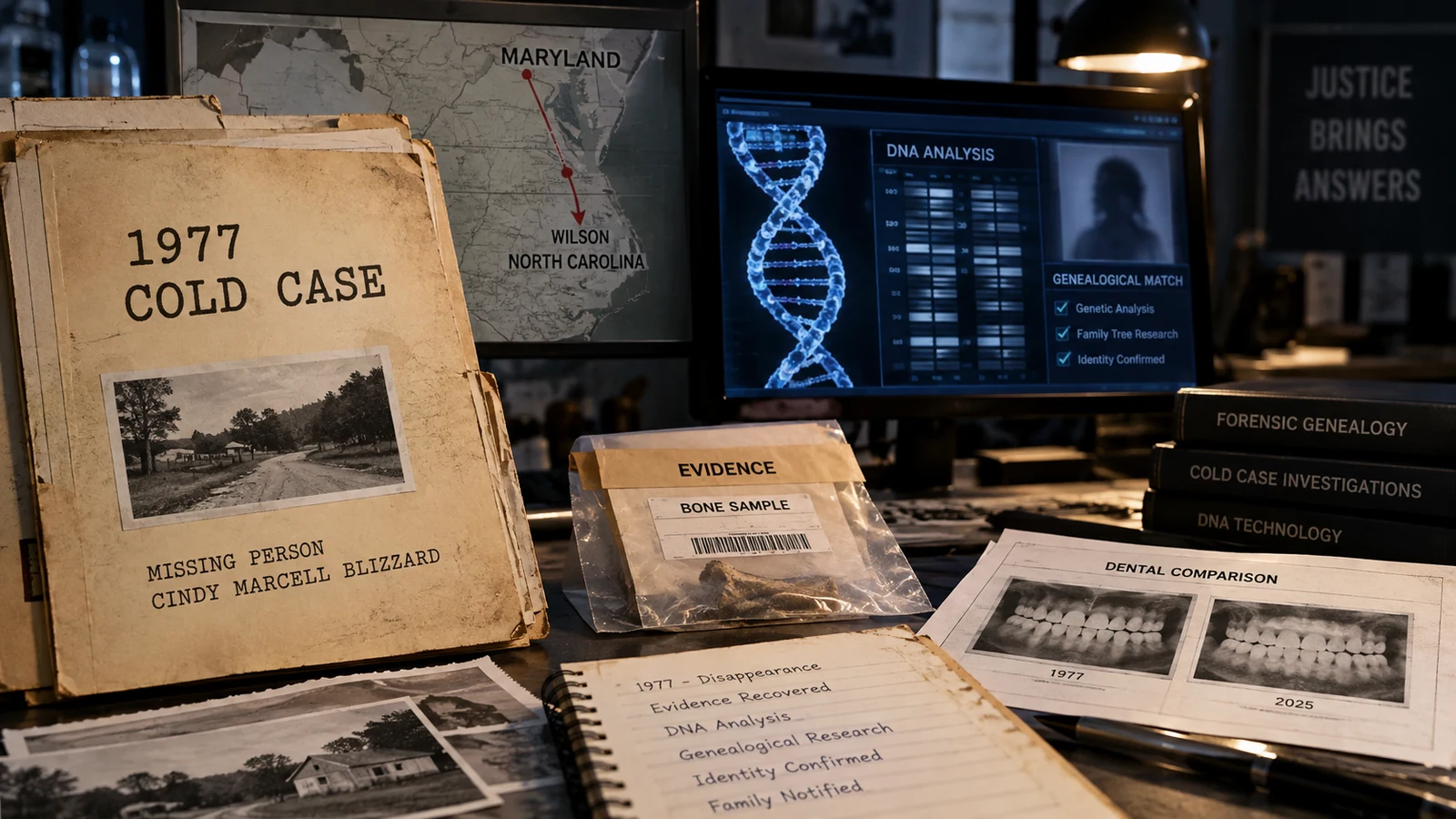
A North Carolina cold case that began before modern DNA profiling existed now has a name. Authorities announced on September 8, 2026 that skeletal remains discovered in Wilson County on December 29, 1977 have been identified as Cindy Marcell Blizzard, a 15-year-old who had disappeared from Monkton, Maryland, earlier that year. The identification answers one of the case’s most basic questions after nearly five decades, but it does not explain how Blizzard died or how she traveled hundreds of miles from her Maryland home to eastern North Carolina.
Investigators continue to treat the case as a homicide because of the circumstances in which the remains were found, even though the medical examiner’s classification of the manner of death was undetermined. The North Carolina State Bureau of Investigation has emphasized that the investigation is active and that authorities still want information from anyone who may know what happened to Blizzard in 1977. The breakthrough also illustrates how forensic genetic genealogy can revive cases that previously exhausted conventional dental comparisons, database searches, and older forms of DNA testing.
What investigators found in Wilson County in December 1977
The remains and clothing were discovered in a wooded area near the Firestone plant in Wilson, North Carolina, on December 29, 1977. The Wilson County Sheriff’s Office and the North Carolina State Bureau of Investigation responded. The Office of the Chief Medical Examiner estimated that the remains belonged to a White female roughly 16 to 23 years old and had likely been in the wooded area for approximately six months to two years. The condition of the remains made visual identification impossible, and investigators did not have the technology available today to extract the kind of genealogical information that ultimately solved the identity question.
The medical examiner could not determine a definitive cause or manner of death, but law-enforcement officials said the location and recovery circumstances raised the probability of foul play. That is why investigators treated the matter as a homicide case despite the undetermined medical classification. For years, detectives compared dental records with missing-person files and followed available leads without finding a match. The unidentified victim remained disconnected from Blizzard’s missing-person case in Maryland, and the investigation eventually went cold.
Why the 2010 DNA effort still did not produce an identity
The case did not remain untouched for the entire 49-year period. In 2010, a state anthropologist reopened the investigation and submitted the victim’s teeth for DNA testing. A profile was developed and entered into national systems including CODIS and NamUs. Those databases are crucial tools for law enforcement and missing-person investigations, but they depend on having a useful comparison profile already in the system. In this case, no matching record surfaced, and the victim remained unidentified.
That failure is important because it shows why newer forensic genealogy can succeed where traditional database matching does not. CODIS is designed around criminal-justice DNA profiles, while genealogical methods can work from a much denser pattern of single-nucleotide polymorphisms, or SNPs, and use family relationships to point investigators toward possible identities. A person does not necessarily need to have a direct DNA sample already stored in a criminal database for genealogical research to generate a lead. Instead, investigators can identify likely relatives and build family connections that narrow a pool of candidates.
How advanced DNA and forensic genealogy led to Cindy Marcell Blizzard
In 2024, the North Carolina SBI Cold Case Investigative Team assigned Special Investigator Andy Murr to review the case again. Working with the medical examiner’s office, investigators determined that preserved evidence qualified for advanced DNA testing. A bone sample was sent to a forensic DNA laboratory, where genetic material was extracted and used to build a SNP profile detailed enough for forensic genealogical work. A genealogy service then traced potential relatives from that profile and produced a lead pointing toward a teenager who had vanished from Maryland in 1977.
That teenager was Cindy Marcell Blizzard. Authorities said she had run away from her home in Monkton, Maryland, in the spring of 1977, when she was 15. Investigators ultimately confirmed the identity with assistance from multiple agencies, including the FBI’s NCIC Investigation and Operational Assistance Group, the Maryland Department of State Police Homicide Unit, and the Raleigh Police Department’s intelligence unit. The announcement means the Wilson County Jane Doe case is no longer an unidentified-person investigation, although the central criminal question remains unresolved.
What remains unknown about Blizzard’s disappearance and death
Authorities have not publicly identified a suspect, a confirmed cause of death, or a detailed timeline explaining Blizzard’s movements after she left Maryland. They also have not said who she may have traveled with, how long she lived after disappearing, or whether anyone in Wilson County knew her under another name. The original estimate that the remains had been in the wooded area for six months to two years was based on the forensic information available in 1977 and does not by itself provide a precise date of death.
Those gaps are why investigators are asking the public for information even after the identification. A person who dismissed a memory as unimportant decades ago may now recognize Blizzard’s photograph or connect her name to a vehicle, job, residence, friendship, or trip from 1977. Cold-case investigations often change once a victim is identified because detectives can reconstruct relationships and locations that were impossible to explore when they did not know who the victim was. Identification is therefore a major milestone, but it is not the end of the case.
Why this case matters beyond one identification
The Blizzard case is part of a wider transformation in U.S. cold-case work. DNA once had to produce a direct match against a known offender or family sample to be immediately useful. Modern forensic genealogy can generate investigative leads from more distant biological relationships, provided the evidence is suitable and the process is conducted under applicable legal and agency rules. That has allowed investigators to revisit unidentified remains, homicides, and missing-person cases that predate digital records by decades.
At the same time, genealogy is not a magic answer. It can identify a victim without identifying a killer, and the original evidence may be degraded, incomplete, or difficult to interpret. In Cindy Marcell Blizzard’s case, the science restored her identity and connected two cases in different states. The next stage depends on traditional investigative work: interviews, archival records, travel history, surviving witnesses, and any physical evidence that can still be analyzed. The SBI says anyone with information about the 1977 case can contact its Cold Case Tip Line at 919-582-TIPS or the Wilson County Sheriff’s Office.
How investigators move from a genealogy lead to a confirmed identity
Forensic genealogy does not normally end with a family-tree suggestion. A genealogist can identify relatives or family branches that make one person a strong candidate, but investigators still need independent evidence before publicly naming remains. That can include direct family DNA comparisons, vital records, missing-person files, age and sex estimates, dental information, geography, and documentary timelines. In Blizzard’s case, the genealogy work pointed investigators toward a Maryland teenager missing since 1977, and law-enforcement agencies in multiple jurisdictions then helped confirm the identity. This verification step is essential because distant relatives can share genetic segments with many people and a family-tree hypothesis can be wrong if records are incomplete or relationships are misunderstood.
The same caution applies to what the identification can establish about the crime. DNA can say whose remains were recovered without proving when the person arrived at the location, who was with her, or what caused her death. Those questions require a separate evidentiary chain. Investigators may re-examine clothing, original scene photographs, property records, employment records from nearby businesses, historical transportation routes, missing-person reports, and witness statements. The identification gives detectives a name around which to organize that evidence for the first time. It also allows surviving relatives and people who knew Blizzard in 1977 to provide context that was unavailable while the victim was known only as an unidentified young woman.
The identification announcement also has a human dimension that can be lost when the story is reduced to a forensic-technology success. For decades, the remains were discussed as an unknown victim while Blizzard’s disappearance existed as a separate family and law-enforcement mystery. Connecting the two restores her name to the case record and gives investigators a chance to ask more specific questions about her life in 1977. Responsible coverage should avoid inventing motives for why she left home or speculating about a killer without evidence. The confirmed facts are already significant: a missing 15-year-old has been identified, foul play is suspected, and the homicide investigation continues.

