

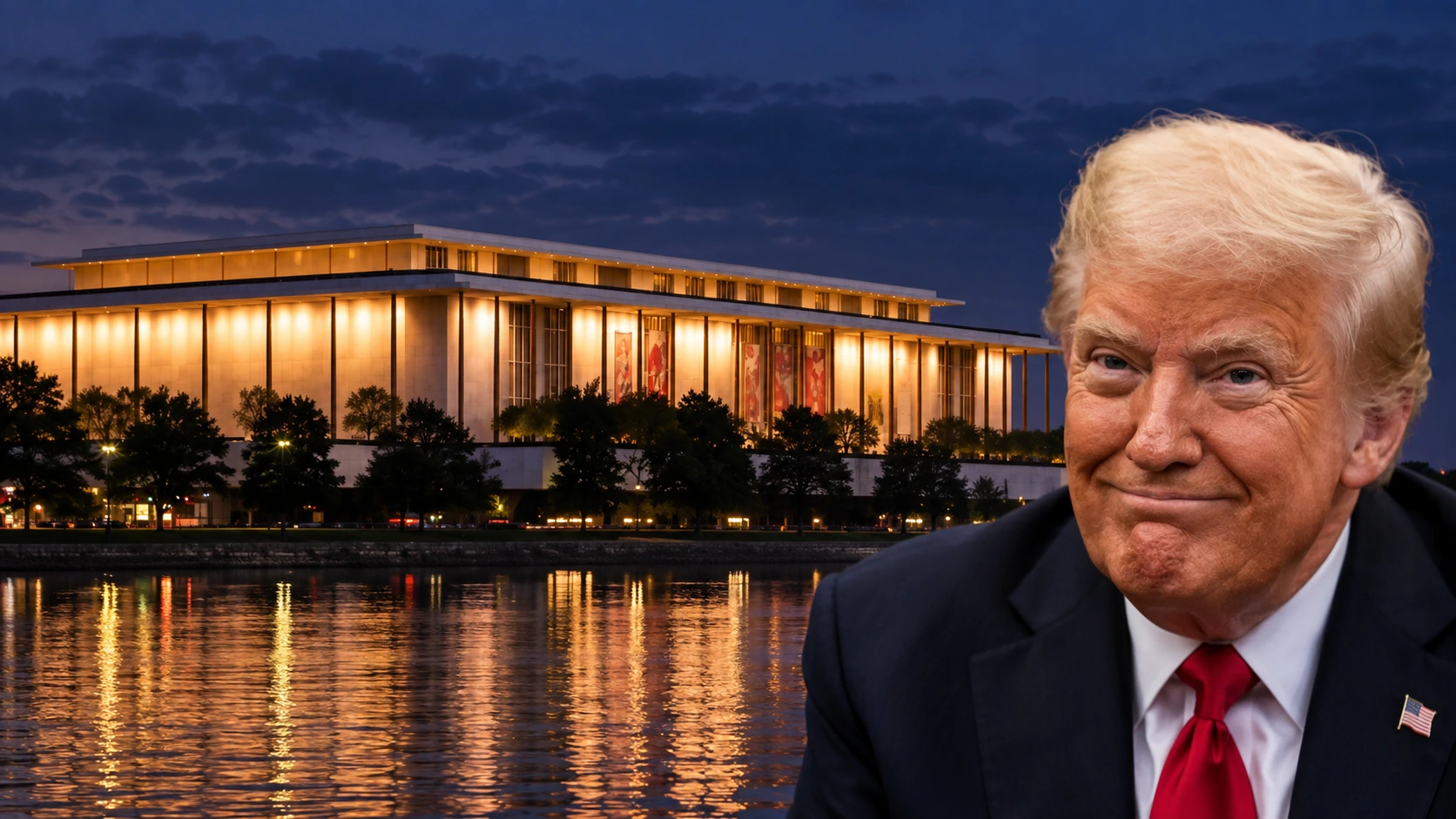
The board overseeing Washington’s John F. Kennedy Center for the Performing Arts is turning its immediate attention to one question: whether the landmark’s main building should close for a major renovation amid new safety concerns.
A federal court filing says the Kennedy Center board’s September 15 meeting will focus exclusively on the proposed closure, temporarily separating that issue from a politically charged dispute over whether President Donald Trump should receive prominent recognition on the building.
The distinction matters.
The Kennedy Center is dealing with several controversies at once: reported structural deterioration, serious financial pressure, an ongoing federal lawsuit and a dispute over the legal limits of its board’s power to change how the congressionally designated memorial is presented to the public.
Reuters reported on September 15 that the board was preparing to consider the future of the venue while litigation over Trump-related recognition continued. Associated Press separately reported on proposed resolutions addressing both the condition of the building and the Center’s financial problems.
For people following the story in the United States, the most important point is that a proposed closure does not mean the Kennedy Center is being permanently abolished. The immediate debate concerns temporarily closing its main building while repairs and renovations are carried out.
Why Is the Kennedy Center Considering a Closure?
Kennedy Center leadership says the physical condition of the main building has become increasingly difficult to manage while keeping it open to the public.
That argument gained urgency after an incident on September 4.
According to documents reviewed by The Washington Post, part of the ceiling plaster in the Grand Foyer fell from a height of approximately 60 feet during a period of water intrusion and deterioration. The latest proposed board resolution specifically cites the partial ceiling collapse as a risk to visitors and employees.
The draft resolution says trustees reviewed reports from Delta Consulting Group and JLL as well as a broader project development plan.
It also states that the board was expected to meet with a Delta Consulting Group principal on September 15 to question the basis for recommending closure during renovation.
Kennedy Center officials argue that continued occupancy could expose patrons and employees to additional risk.
That is the Center leadership’s position. It should not, however, be confused with an uncontested independent finding that every part of the Kennedy Center complex is unsafe.
Rep. Joyce Beatty of Ohio, an ex-officio Kennedy Center trustee who is challenging board actions in federal court, has questioned the way the Center has characterized outside consultants’ conclusions. AP reported that her lawyers dispute portions of the safety and financial case being presented by Kennedy Center leadership.
That disagreement is important because building safety has now become part of the legal justification for a new closure vote.
This Is Not the Board’s First Attempt to Close the Kennedy Center
The current proposal has a significant legal history.
An earlier board decision called for winding down programming and closing the Center’s doors during a roughly two-year renovation.
That decision ended up before U.S. District Judge Christopher R. Cooper in the federal case Beatty v. Trump.
On May 29, Cooper blocked implementation of that earlier closure decision. His ruling did not, however, say the Kennedy Center could never close for renovation.
Instead, the judge concluded that the earlier decision had been made in violation of the trustees’ duty of prudence based on the record before the court.
The federal court specifically said its ruling should not stop necessary maintenance and repair work. It also made clear that the board was not automatically barred from approving a future closure if it properly considered the evidence and fulfilled its legal responsibilities.
That distinction explains much of what is happening now.
The board is attempting to build a more detailed record covering safety assessments, renovation planning, financial conditions and the consequences for artistic programming before taking another vote.
What Would Actually Close?
The current proposal is focused on the main Kennedy Center building, not the complete elimination of the institution.
According to the proposed resolution published by The Washington Post, the Center would continue some educational and artistic programming at the REACH, the newer expansion of the Kennedy Center campus.
The proposal also calls for continued support for the National Symphony Orchestra at off-site venues.
Major signature programs, including the Kennedy Center Honors and the Mark Twain Prize for American Humor, could also be presented elsewhere during the renovation period.
The John F. Kennedy memorial would be temporarily relocated to the REACH and remain accessible to the public under the proposal.
The board’s plan anticipates a renovation period of roughly two years, with the goal of returning programming to a revitalized main building in 2028.
That means headlines suggesting that the Kennedy Center may “close” require context. The proposal concerns a temporary building shutdown rather than the disappearance of the Kennedy Center as a cultural institution.
What Would a Closure Mean for Visitors and Performers?
For ordinary visitors, the biggest immediate effect would be the loss of access to the main Kennedy Center building during construction.
People who normally attend theater, dance, orchestral performances and other events at the complex could see productions moved, rescheduled or presented at alternative venues.
National Symphony Orchestra performances would need off-site arrangements.
Artists and production teams could also face scheduling and logistical changes because the Kennedy Center contains several major performance spaces under one roof.
A temporary shutdown could therefore create significant disruption even if programming continues elsewhere.
At the same time, keeping portions of the institution active at the REACH and off-site venues could prevent a complete interruption of the Center’s cultural and educational activities.
Whether that model can maintain audience attendance, donor engagement and sufficient revenue over a two-year period remains one of the larger unanswered questions.
Financial Problems Are a Separate but Closely Connected Issue
The building’s condition is not the Kennedy Center’s only problem.
Documents prepared for trustees portray the organization as facing an extremely difficult financial situation.
The Washington Post reported that Kennedy Center leadership warned of what it described as an approaching “fiscal collapse,” including concerns about meeting payroll and routine maintenance expenses. Reuters has also reported on the Center’s financial problems as part of the current dispute.
Those descriptions come from Kennedy Center leadership and should be attributed accordingly rather than treated as an independent declaration that bankruptcy is inevitable.
There is also disagreement over why the institution is under such pressure.
Trump-aligned Kennedy Center officials have blamed previous management and years of deferred maintenance.
Critics of the current leadership point to disruptions following Trump’s takeover, including artist withdrawals, changes in programming and concerns about ticket sales and fundraising.
Reuters reported that reduced revenue, artist and company boycotts and management controversy have become part of the financial picture.
Establishing the exact share of responsibility for the Center’s current finances will require more than political claims from either side.
Why Is Donald Trump at the Center of the Story?
Trump is not simply commenting on the Kennedy Center from outside the organization.
He became chairman of its Board of Trustees after replacing members of the board and reshaping its leadership.
The federal court record describes how the newly reconstituted board elected Trump chairman and later replaced the Center’s president.
His leadership has made the institution part of a wider debate in Washington about presidential power, cultural institutions and political influence over federally connected organizations.
The most contentious issue has involved attempts to associate Trump’s name with the Kennedy Center itself.
Why Is Trump’s Name Such a Major Legal Issue?
The Kennedy Center is not simply a privately owned theater whose board can freely choose a new commercial name.
Congress designated the institution as a living memorial to President John F. Kennedy.
The Center’s statutory identity therefore limits what its trustees can do with the name.
The Trump-aligned board previously moved to attach Trump’s name to the institution.
Judge Cooper ruled against that effort in May, and Trump’s name was subsequently removed from the building. The D.C. Circuit later denied an effort to stay the ruling while the case continued.
Reuters reported that the court determined the board did not have authority to rename the congressionally designated Kennedy memorial on its own.
The legal question is therefore not simply whether board members believe Trump deserves recognition.
It is whether that recognition crosses the line into altering the identity of a memorial whose name and purpose were established by Congress.
The Board Later Considered a Different Approach
After the earlier legal setback, the Kennedy Center board considered language that would recognize Trump without formally replacing John F. Kennedy’s name.
Reuters reported that the board voted in August for signage describing the institution as having been “Restored and Renovated by President Donald J. Trump.” It also backed calling the surrounding grounds the “President Donald J. Trump Plaza.”
Beatty again challenged the plan.
Her position is that adding Trump’s name to the Kennedy memorial in this manner still conflicts with the court’s earlier ruling and the federal law governing the Center.
Trump-aligned officials argue that recognition for his role in renovation and fundraising would not be the same thing as formally renaming the institution.
That disagreement remains unresolved.
Why Was Trump Recognition Connected to the Financial Crisis?
Draft documents circulated ahead of the September meeting introduced another controversial issue.
One proposed resolution said the Center wanted to find a lawful way to recognize Trump because, according to Kennedy Center leadership, his involvement could be essential to fundraising and overseeing the renovation.
The document presented multiple possible inscriptions recognizing Trump’s role in restoration, financial support or an associated fundraising effort.
That proposal immediately created two very different interpretations.
Supporters can argue that recognizing a person who helps raise large amounts of money for a major restoration project is not unusual.
Critics argue that a national memorial’s financial survival should not depend on giving a sitting president prominent personal recognition on the building.
Those are competing political and ethical interpretations. Neither should be presented as an established fact.
Why Is the September 15 Filing So Important?
The latest development separates the two fights, at least temporarily.
According to reporting on the court filing, the Kennedy Center board’s meeting is now expected to focus exclusively on the proposed closure.
That means trustees are not currently expected to use the same meeting to approve one of the new Trump-recognition options.
The Guardian reported that the board shifted its immediate focus to closing the building for renovations while moving away from a simultaneous vote to restore Trump-related language to the facade.
Legally, that separation could matter.
The board can now argue that its closure vote should be evaluated primarily on evidence involving building safety, construction logistics and the trustees’ statutory responsibilities rather than on the separate controversy surrounding Trump’s name.
It does not mean the Trump-recognition dispute has disappeared.
What Has Trump Himself Said?
This part of the story requires careful wording because statements by Kennedy Center officials should not automatically be attributed personally to Trump.
Trump has strongly supported renovating the Kennedy Center and previously announced his desire for a major closure and rebuilding project.
The federal court’s May opinion notes that Trump had publicly announced a roughly two-year closure for “Construction, Revitalization, and Complete Rebuilding” before the board subsequently approved its earlier shutdown plan.
More recently, Commerce Secretary Howard Lutnick promoted the argument that the Center’s physical condition demonstrates the need for major renovations. The Guardian reported that Trump amplified Lutnick’s video on social media.
However, as of the reporting reviewed through September 15, there was no substantial new direct Trump statement specifically responding to the latest court filing saying that the board meeting would focus exclusively on closure.
That distinction is important.
It would be inaccurate to say that Trump personally announced the September 15 closure decision. The issue is being handled through the Kennedy Center board and the ongoing federal court process, although Trump remains deeply involved as chairman.
Why This Matters Beyond Washington Politics
The controversy matters to Americans for reasons that extend beyond Trump or partisan politics.
Public Safety Comes First
If structural deterioration creates a significant risk to audiences, performers or staff, renovation may require closing major portions of the building regardless of who controls the board.
The reported ceiling failure makes those concerns more difficult to dismiss.
At the same time, because the closure is already the subject of litigation, the board must demonstrate that its decision is based on adequately reviewed evidence rather than simply asserting that an emergency exists.
The Case Tests the Governance of a National Cultural Institution
The Kennedy Center occupies an unusual position in American public life.
It is a performing arts venue, a national cultural institution and a congressionally established memorial to an assassinated president.
That makes decisions about its name, physical identity and governance different from decisions made by an ordinary private arts organization.
The Dispute Raises Questions About Presidential Influence
Presidents routinely appoint people to government and federally connected institutions.
What makes this dispute unusual is Trump’s personal position as board chairman combined with proposals to place his own name prominently on the memorial.
Supporters see his involvement as hands-on leadership aimed at rescuing and restoring the institution.
Opponents see it as an attempt to reshape an independent cultural landmark around the political identity of a sitting president.
The courts are now helping determine where the legal limits lie.
What Happens Next?
The immediate question is whether the board approves a new closure resolution after reviewing the additional safety and renovation information.
Even if trustees vote in favor, federal litigation could continue.
Because Judge Cooper previously blocked the earlier closure decision but explicitly left open the possibility of a properly considered future vote, the quality of the board’s new record could become central to the next phase of the case.
The Trump-recognition issue is also likely to remain alive even if it is not addressed at this particular board meeting.
Another major question is financial.
A two-year renovation could solve some long-term building problems while creating short-term challenges involving ticket revenue, donations, staffing and alternative performance venues.
How much funding can be secured — and under what conditions — may ultimately be as important as the legal fight.
The Bottom Line
The latest Kennedy Center controversy involves three separate issues that should not be confused.
First, the board is considering temporarily closing the main building for a large-scale renovation after new reports of physical deterioration and a partial ceiling collapse.
Second, the Kennedy Center leadership says the institution is under serious financial pressure, although the causes and severity of that crisis remain politically disputed.
Third, a separate legal battle continues over efforts to publicly recognize Donald Trump on a congressionally designated memorial to John F. Kennedy.
The September 15 court filing is significant because the upcoming board meeting is expected to focus exclusively on the closure question, rather than combining it with a new vote on Trump-related recognition.
The Kennedy Center itself is not being permanently eliminated. Under the proposed plan, programming would continue at the REACH and other venues while the main building undergoes a roughly two-year renovation.
For the United States, the larger issue is no longer simply whether an aging performing arts complex needs repairs. The dispute has become a test of how safety, public money, presidential influence, congressional authority and the identity of a national memorial can coexist inside one of Washington’s most recognizable cultural institutions.
Sources and Documents Reviewed
This report is based on the May 29, 2026 federal ruling in Beatty v. Trump, subsequent federal court proceedings, Reuters reporting dated September 15 and August 19, 2026, Associated Press reporting, and reporting and draft board documents published by The Washington Post. The Guardian was used for the latest reporting concerning the September 15 meeting and Trump’s amplification of the administration’s renovation argument.
Claims from Kennedy Center leadership, Rep. Joyce Beatty’s attorneys and political officials are identified as claims or positions rather than presented as independently established facts.

