

Retroid’s next Android handheld is taking direct aim at players who want a modern Nintendo DS- and 3DS-style form factor without relying on a clip-on second screen. The Retroid Pocket Duo is a clamshell device with two built-in OLED displays, both refreshing at 120Hz. Retroid has been revealing the machine in stages during the first week of September 2026, and the latest details now establish its chipset, screen sizes, battery capacity, software version, controls, hinge design and color options. On September 10, Retroid also revealed pricing: the standard Pocket Duo is $249 during the preorder period and $269 at regular retail, while the Pocket Duo Lite starts at $135. A specific shipping date has not yet been announced.
The Pocket Duo will use Qualcomm’s Dragonwing Q-7790 rather than the Snapdragon-branded chips familiar from many gaming handhelds. The top display is a 5.5-inch 16:9 OLED, while the lower display is a 4.5-inch 4:3 OLED. Retroid is pairing those panels with Android 16, a 6,000mAh battery, active cooling and a 180-degree free-stop hinge. The company has also revealed a cheaper Pocket Duo Lite with lower-end hardware, making it clear that the Duo name will represent a small family rather than a single experimental device.
Retroid Pocket Duo uses two 120Hz OLED displays with different shapes
The most unusual specification is not simply that there are two screens, but that Retroid gives them different aspect ratios. The upper 5.5-inch panel is 16:9, which is well suited to PSP, widescreen Android games, streaming and other modern content. The lower 4.5-inch panel is 4:3, a shape that more closely matches many classic systems and gives dual-screen emulators a more natural secondary workspace. Both displays are OLED and both refresh at 120Hz, avoiding the common compromise where only the primary panel receives the faster refresh rate.
That layout creates flexibility but also introduces software questions. Nintendo DS games were designed around two similarly shaped screens, while Nintendo 3DS software has its own screen-size relationship. Android emulators will need to place and scale each virtual display intelligently across Retroid’s mismatched panels. The 4:3 lower screen can also be useful outside dual-screen emulation for menus, touch controls, maps or secondary applications. How easy Retroid makes screen assignment and rotation will be just as important as panel quality.
The Dragonwing Q-7790 is a surprising choice for a gaming handheld
Retroid has confirmed the Qualcomm Dragonwing Q-7790, an embedded and IoT-focused platform that is technically close to the Snapdragon 7 Gen 4 family rather than a flagship Snapdragon 8-series chip. Qualcomm lists an eight-core Kryo CPU running at up to 2.8GHz, an Adreno 722 GPU at up to 1.15GHz, LPDDR5X support and a 24-TOPS NPU. The platform also supports modern connectivity including Wi-Fi 7 and Bluetooth 6 when paired with appropriate companion hardware.
The choice places the Pocket Duo in an interesting performance tier. It should offer more modern CPU and GPU capabilities than older Snapdragon 865-class handhelds, but it is not intended to match Snapdragon 8 Gen 2-class machines in every workload. That may be deliberate. Two OLED panels, a hinge and larger battery increase bill-of-material costs, so Retroid can spend less on the processor while keeping the dual-screen hardware attractive. Retroid’s newly revealed $249 preorder price puts the standard Duo below the $269 regular retail figure and makes the two-screen hardware unusually aggressive for this performance class.
A 6,000mAh battery and active cooling target sustained emulation
Retroid says the Pocket Duo will use a 6,000mAh battery and include a cooling fan. Active cooling is important in a clamshell because sustained emulation and Android gaming can keep the processor under heavy load for long periods. Qualcomm’s Q-7790 is designed for edge devices operating within constrained thermal envelopes, but handheld performance still depends on how aggressively Retroid sets power limits and fan curves. A processor that benchmarks well for a few minutes can behave very differently after an hour if heat is not managed.
The battery capacity is generous for a compact retro handheld, although two bright 120Hz OLED screens can consume significant power when used simultaneously. Users should expect endurance to vary dramatically by emulator, brightness, refresh rate, wireless activity and whether both panels stay active. Retroid has not published an official runtime estimate yet. Practical testing will also need to show whether the hinge blocks airflow or directs warm exhaust toward the player’s hands during long sessions.
Controls are designed around a D-pad-first dual-screen layout
Retroid places the D-pad and ABXY face buttons above two recessed, symmetrical analog sticks. That is a deliberate departure from asymmetric layouts common on Xbox-style controllers and several competing handhelds. The upper placement favors games where the D-pad or face buttons are used more often than analog movement, which makes sense for systems such as Nintendo DS, Game Boy Advance, Super Nintendo and many classic arcade titles. The sticks remain available for 3D games but sit lower in the chassis.
The company also lists tactile-click ABXY buttons and stacked shoulder controls. Because the device folds, Retroid has to balance control comfort against the depth needed for two displays, a battery, cooling and a hinge. Recessing the sticks helps keep them from colliding with the upper half when closed, but it can change leverage and thumb angle. Ergonomics will therefore be one of the biggest unanswered questions until reviewers can hold production hardware for extended sessions.
The 180-degree free-stop hinge could be useful beyond emulation
The Pocket Duo’s hinge can reportedly hold the upper display at different angles and open as far as 180 degrees. A free-stop design lets users choose a comfortable viewing angle on a desk or lap rather than relying on one fixed open position. It can also make the system useful for game streaming, video playback or Android apps where the upper display acts like a small laptop screen and the lower panel carries controls or secondary information.
Hinge durability will be critical because the Duo’s value proposition depends on repeatedly opening and closing the device. The mechanism must remain firm enough to hold the screen without becoming stiff, loose or uneven over time. Retroid’s earlier Pocket Flip line gives the company clamshell experience, but a dual-screen chassis increases complexity. Reviewers should pay attention to wobble, cable routing through the hinge, screen protection and whether the device can be comfortably used completely flat.
Android 16 gives the Pocket Duo a modern software base
Retroid plans to ship the standard Pocket Duo with Android 16. A newer Android base can improve security, app compatibility and long-term support, but dual-screen gaming depends on Retroid’s own software layer as much as the operating system. Users will need easy controls for choosing which display runs an app, arranging emulator screens, changing orientation, adjusting refresh rates and disabling a panel when it is not needed. A polished launcher could make those tasks feel seamless; poor controls could make the hardware frustrating.
Android also gives the device broader uses than emulation. Native Android games, cloud gaming, remote play, media apps and productivity utilities can all run on the system, subject to compatibility and DRM support. Qualcomm’s platform includes hardware video decode capabilities and modern graphics features, so the Duo should be capable as a small media device. The unresolved issue is whether popular games and services correctly recognize the unusual two-display arrangement or require manual setup.
Pocket Duo Lite shows how Retroid plans to segment the lineup
Retroid has also announced a Pocket Duo Lite aimed at buyers who want the dual-screen form factor at a lower price. The Lite uses 60Hz LCD panels instead of 120Hz OLED, with a 5.5-inch 16:9 upper display and a smaller 4.2-inch 4:3 lower display. It uses Qualcomm’s older QCS6125 platform, ships with Android 15 and uses in-line shoulder buttons rather than the standard Duo’s stacked arrangement. Both models share a 6,000mAh battery and a free-stop hinge.
The Lite clarifies how Retroid is segmenting the lineup. Rather than forcing one device to cover both value and performance buyers, the company keeps OLED, 120Hz panels and the faster Q-7790 on the premium model while using the Lite to reach a much lower entry point. The Lite starts at $135, while the standard Duo is $249 during the preorder period and $269 at regular retail. Those figures make the Lite especially interesting for buyers focused on Nintendo DS-era emulation rather than demanding higher-end systems.
Five colors and aggressive pricing sharpen the Duo’s position
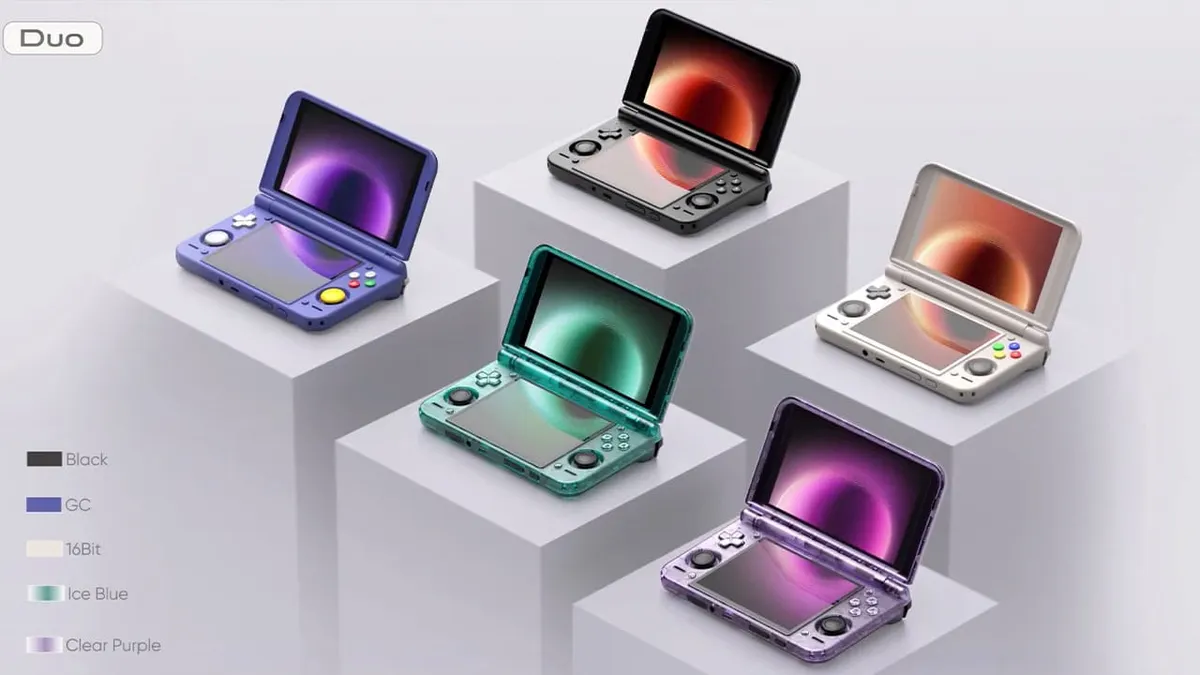
Retroid says the standard Pocket Duo will be sold in Black, GC, 16Bit, Ice Blue and Clear Purple. The last two are transparent finishes, giving the device the nostalgic look many retro-handheld buyers prefer. The same broad color selection is planned for the Duo Lite. This is more choice than an early teaser suggested and indicates Retroid is preparing the Duo as a mainstream product line within its catalog rather than a limited specialty model.
As of September 10, 2026, the standard Duo is positioned at $249 during the preorder window and $269 at regular retail, with the Lite starting at $135. Retroid has not yet provided a firm shipping date, so availability timing remains the major unresolved purchase question. The value case is nevertheless much clearer than it was a day earlier: dual 120Hz OLED screens, Q-7790 performance, a 6,000mAh battery and a clamshell built specifically for two-screen play are being offered at a price below many enthusiasts expected.

