

MapQuest, the digital mapping service that many Americans remember from the days of printing driving directions before road trips, has suddenly returned to the top of the tech world.
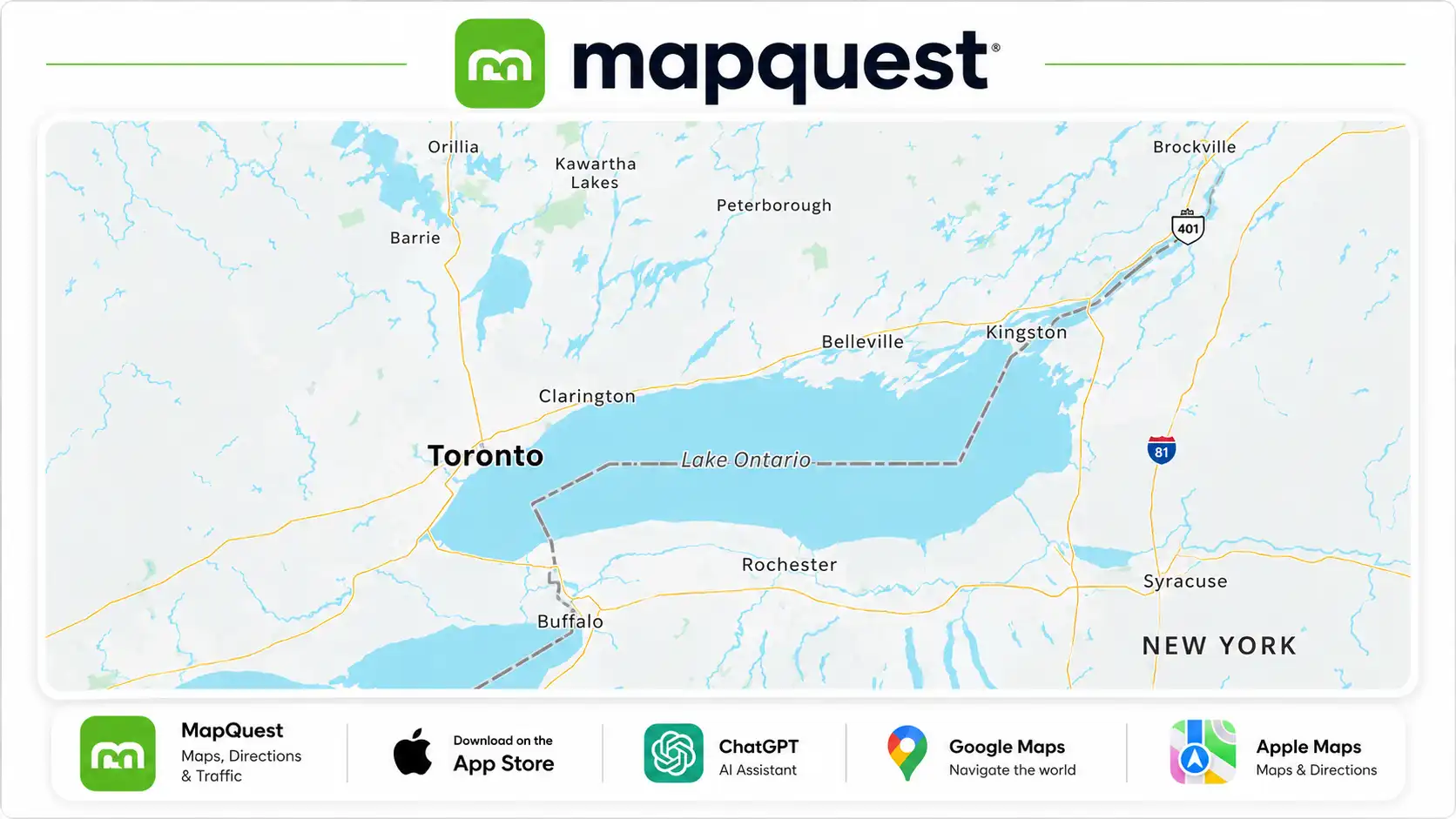
As of Tuesday, September 1, the 30-year-old mapping service had climbed to the No. 1 spot among free apps in Apple’s U.S. App Store, overtaking ChatGPT after MapQuest publicly refused to replace “Lake Ontario” with “Lake America” on its maps.
The unexpected comeback followed President Donald Trump’s August 27 executive order directing the federal government to use “Lake America” as the U.S. name for Lake Ontario.
MapQuest responded the same day with a short message on social media: “We’re not changing it.”
That statement quickly went viral and appears to have transformed a decades-old internet brand into one of the most talked-about apps in America.
MapQuest Downloads Explode After Lake Ontario Decision
MapQuest said hundreds of thousands of people downloaded its app after it announced that Lake Ontario would retain its familiar name on the platform.
The company also reported that usage surged to roughly 50 times its normal level.
Independent mobile-market data confirmed a dramatic increase. Sensor Tower estimated that MapQuest recorded about 184,000 global downloads and 162,000 U.S. downloads during the week beginning August 24, representing more than a tenfold week-over-week increase.
The momentum continued through the weekend.
MapQuest initially climbed to No. 1 in Apple’s Navigation category and No. 4 among U.S. free apps. By September 1, it had moved all the way to the No. 1 free-app position, its highest ranking in the company’s three-decade history.
ChatGPT was ranked behind MapQuest as the second-most downloaded free app when the latest rankings were reported.
Why MapQuest Is Keeping the Lake Ontario Name
MapQuest says its strategy is simple: continue showing geographic names that users already recognize.
“We took the same approach we did with the Gulf of Mexico: be part of the conversation, and give people an app that keeps the names they’re familiar with,” MapQuest General Manager Doug Berger said while discussing the surge.
Berger said the wave of downloads suggested that hundreds of thousands of users agreed with that decision.
It is important, however, to distinguish the federal order from a requirement imposed on private mapping companies.
Trump’s executive order directs U.S. federal agencies to recognize the lake as “Lake America.” It does not give the United States authority to rename the lake for Canada or require every private mapping platform to adopt the designation.
Lake Ontario straddles the border between New York and the Canadian province of Ontario.
Google Maps Takes a Different Approach
Google Maps has chosen a different path.
After the U.S. Geographic Names Information System updated its designation, Google began displaying “Lake America” to users in the United States.
Canadian Google Maps users continue to see “Lake Ontario,” while users in some other countries may see both names.
Google says its approach follows a longstanding policy of using official government geographic databases when names differ between countries.
Apple, meanwhile, had not made the same change as of the latest September 1 reports. Apple Maps was still displaying Lake Ontario, even after Interior Secretary Doug Burgum said Trump had personally contacted Apple and asked the company to adopt “Lake America.”
The contrasting decisions have placed mapping platforms at the center of an unusual political and cultural debate over who gets to determine the names people see on digital maps.
MapQuest Lets Users Rename the Lake Themselves
MapQuest has also turned the controversy into an online engagement campaign.
The company launched a tool that allows users to create their own unofficial name for Lake Ontario and see it displayed on a mock map.
The feature has helped keep MapQuest circulating on social media, where many younger users have discovered the service for the first time while older internet users have reacted with nostalgia.
MapQuest launched its online mapping service in the 1990s and became one of the defining websites of the early internet era.
Before smartphones and built-in GPS navigation became common, millions of drivers used MapQuest to generate step-by-step directions and print them before leaving home.
Google Maps, Apple Maps and smartphone navigation eventually pushed the once-dominant service into the background.
Three decades later, a dispute over the name of a Great Lake has unexpectedly put MapQuest back in the spotlight.
Trump’s Lake America Order Comes Amid U.S.-Canada Trade Fight
The naming controversy is unfolding during a much larger dispute between Washington and Ottawa.
U.S.-Canada trade negotiations recently broke down, after which the United States imposed 50% tariffs on roughly $20 billion worth of Canadian goods.
Canada announced retaliatory tariffs covering a similar value of American products.
Trump signed the Lake Ontario executive order on August 27, directing the Interior Department to update federal geographic records with “Lake America.”
Canada is not required to recognize the designation.
Canadian Prime Minister Mark Carney, Ontario Premier Doug Ford, Indigenous leaders and several U.S. officials have criticized the change.
The controversy follows Trump’s earlier move to use “Gulf of America” as the U.S. federal designation for the Gulf of Mexico.
Most Americans Oppose the Lake America Name
A Reuters/Ipsos poll released September 1 suggests that MapQuest’s position may align with the views of a large share of Americans.
The survey of 1,023 U.S. adults found that 63% opposed renaming Lake Ontario as Lake America.
Only 14% supported the change.
The poll also found significant opposition to the administration’s latest Canadian tariffs, indicating that both the symbolic naming dispute and the larger trade conflict face resistance among many U.S. voters.
An Unexpected Comeback for a 30-Year-Old Internet Brand
For MapQuest, the controversy has produced something few technology companies manage to achieve decades after losing their dominant market position: renewed cultural relevance.
Its surge does not necessarily mean MapQuest is about to replace Google Maps or Apple Maps for millions of everyday users. Download spikes triggered by viral events can fade quickly.
But a reported 50-fold jump in usage suggests that at least some people are doing more than simply downloading the app as a political statement.
For a company born during the early days of the consumer internet, becoming America’s No. 1 free iPhone app in 2026 is an extraordinary reversal.
MapQuest spent years being remembered as the website people once used to print driving directions.
Now, one decision about two words on a map — “Lake Ontario” — has put it back on top.

