

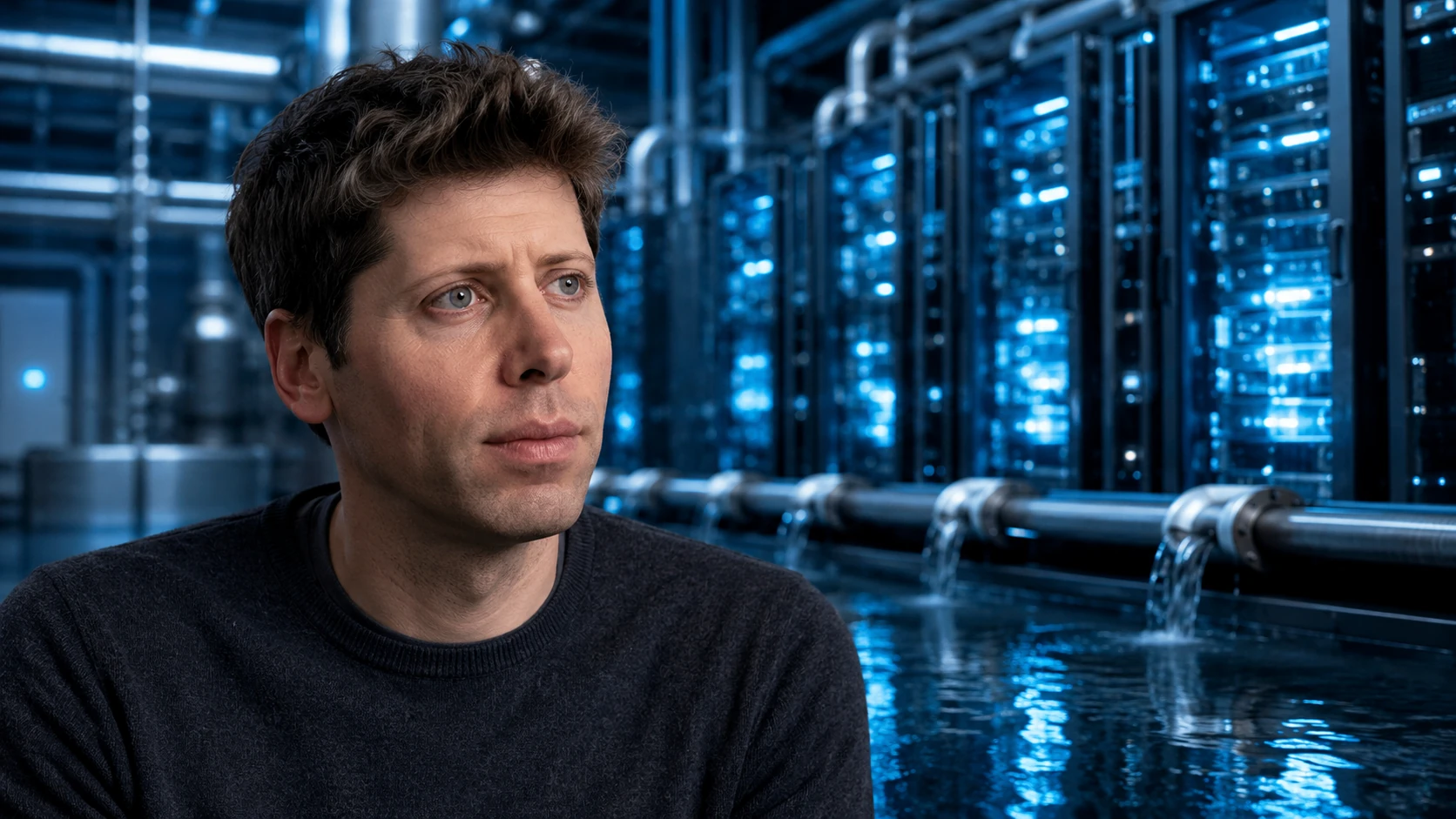
OpenAI CEO Sam Altman has stepped into one of the fastest-growing controversies around artificial intelligence: water. In a new Sources podcast interview, Altman argued that fears about AI data centers guzzling water have become detached from how modern infrastructure works. His comparison was striking: roughly 38,000 ChatGPT queries, he said, use about as much water as producing a single California almond.
As of September 4, 2026, that claim is spreading widely — but outsiders cannot verify it.
Altman acknowledged he was recalling the figure from memory. Independent experts told CalMatters that the public data needed to audit a precise per-query number does not exist. Water use changes with data-center location, cooling system, weather, electricity mix, model, prompt length and reasoning load.
The math behind Altman’s claim
Altman’s comparison is not disconnected from a number he published earlier. In 2025, he wrote that an average ChatGPT query used about 0.000085 gallons of water, roughly 0.32 milliliters.
Multiply that by 38,000 and the result is about 3.23 gallons. Published estimates for the water footprint of California almonds vary substantially by methodology, place and year.
So the comparison can be internally consistent with Altman’s earlier estimate. But internal consistency is not independent verification.
The problem is scope. Does a “ChatGPT query” number count only cooling water at the data center? Does it include water consumed to generate electricity? What about chip manufacturing? Altman said his latest comparison reflected broad water accounting, but OpenAI has not publicly released a detailed methodology researchers can reproduce.
Why older ChatGPT estimates look so different
A peer-reviewed 2025 paper led by UC Riverside researchers estimated that GPT-3 could consume a 500-milliliter bottle of water for roughly 10 to 50 medium-length responses, depending on where and when it ran. That estimate included on-site cooling and off-site water associated with electricity generation.
It was based on GPT-3-era infrastructure, not today’s ChatGPT systems.
That distinction matters. A 2025 Lawrence Berkeley National Laboratory review found that data-center workload water use can vary by more than 10,000 times depending on server efficiency, grid water intensity, utilization, cooling technology, climate and other factors.
There is no scientifically defensible universal number for every AI prompt.
The U.S. data-center footprint is still growing
Even if a modern ChatGPT request uses only a tiny amount of water, national scale is a different question.
Berkeley Lab estimated that U.S. data centers directly consumed about 66 billion liters — roughly 17.4 billion gallons — in 2023, up from 21.2 billion liters in 2014. The report also estimated an indirect water footprint of nearly 800 billion liters from electricity used by data centers.
Those figures cover U.S. data centers overall, not OpenAI or AI alone. But they show why focusing only on one prompt can miss the infrastructure issue.
Virginia offers a useful example. A state review found that most individual data-center buildings used about as much water as, or less than, an average large office building — around 6.7 million gallons annually. Yet 11 buildings used more than 50 million gallons each in 2023, and one consumed 243 million gallons.
Virginia data centers used an estimated 2.1 billion gallons that year, less than 0.5% of statewide withdrawals. Locally, however, data centers accounted for between 2% and 21% of usage at the utilities examined.
That is the central logic: a small statewide percentage can still create meaningful local pressure.
Why Americans are paying attention
The issue has become political because data centers are increasingly local infrastructure projects, not abstract cloud services.
A Gallup survey published in May found 71% of Americans opposed building AI data centers in their local area, including 48% who strongly opposed them. Seventy percent expressed substantial concern about environmental impacts.
California is now debating greater disclosure. Two bills passed by lawmakers would require more transparency about data-center water sources, usage and infrastructure plans; as of September 4, they were awaiting Gov. Gavin Newsom’s decision.
The bottom line
Altman is probably right that viral claims suggesting every ChatGPT question consumes an enormous amount of water can be misleading, especially when they rely on older hardware and unclear assumptions.
But the opposite simplification — that AI water use is negligible because one prompt is tiny — is also incomplete.
For U.S. communities, the real question is not whether someone should feel guilty about asking ChatGPT a question. It is where massive new computing capacity will be built, what cooling systems those facilities use, what water they draw, how much they need during the hottest days, and whether local utilities can support that demand.
The almond makes a memorable comparison. The infrastructure is the real story.

